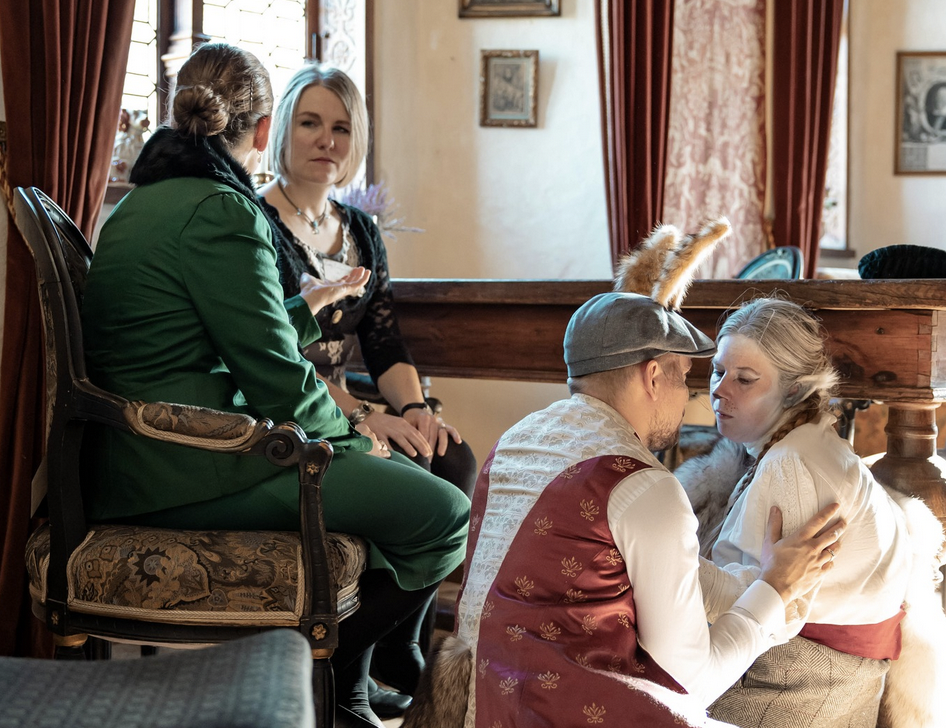
The Authority – this world’s God – is dead. He has been killed by bold and visionary people and amongst them were some of you. Others were on his side. You will play scholars, low nobility, scientists, nomads, people formerly of The Church or people identifying as witches to celebrate the victory and explore the possibilities under the new world order. The soldiers are returning from the war on The Authority, and the world has sunk into a collective state of disillusionment and for some; euphoria. Imagine the divine entity that was as natural a part of your life as breathing the air around you – gone.
Some of you helped bring him down; a frail, pathetic being holding humanity in his grasp with false teachings and zealots doing his bidding. The Magisterium, the harsh church of The Authority, is no longer and you will be forced (more or less willingly) to question all its teachings. But now, another problem has arisen. The Magisterium dropped bombs filled with white powder in many places in the country as a last, desperate act. Some scientific instruments are measuring strange phenomena and there are rumours that the powder affects the bond between human and Daemon. Therefore, the ones of you who have not been to war, have been kindly offered by Parliament to come to the Blackett estate and remain there with some of the country’s top scientists until further notice so they can ensure that everything is alright. There is probably nothing to worry about but you have all taken the invitation.
Lady Philippa Blackett and her daemon Aleko have welcomed everybody in question with open arms since she has already planned a marvelous weekend to celebrate the war heroes. Her brother Lord Edward Blackett and his lynx daemon Liza was an officer that was killed in the war, and Lady Blackett is overjoyed to offer a free space for science to look into matters never previously investigated. She has also insisted that you celebrate the victory of science and free will with some of the returning war heroes calling it “The Birth of the Scientific Age”. To be sure, the soldiers will need help processing the horrors of the war and perhaps their own actions and a little party should be a good start to help with that. Also, there is a sense of ecstasy amongst those of you who will enjoy a new regime, and a proper celebration as well as marvelous toasts to the fallen are in order as well as discussions regarding the new world order.
So, you have accepted the invitation for different reasons.Some of you seek conciliation.
Some come to seek answers.
And some come to start a new world.
What are Daemons?
A Daemon takes the form of an animal and represents the soul or inner self of the human – so in this world the soul exists very literally, and it lives outside the human. A Human-Daemon pair can hear each other’s thoughts, and if one feels pain so does the other. If the human is in conflict with itself, the relationship with the Daemon might be harsh or even abusive. If the human is balanced and at peace, it might be the perfect symbiosis.
A Daemon will often represent either a part of the personality that the human suppresses or is a more correct representation of the human’s inner world. Together, they are a whole person. Usually, the Daemon will take the form of animals in the size range from a moth to a wolf. Larger animals are very rare. Before puberty, the Daemon will be able to change form to most kinds of animals, but when the human becomes more of a defined person and “starts losing its innocence” as the Magisterium would say, it will settle on one specific form for the rest of its life.
Daemons can talk just like humans and some of the discussions internally in the human are materialized in conversations between the human and Daemon. Often in conversations with others, the humans will be talking to each other or doing something together, and the Daemons will show how the two humans actually feel about each other while either talking between themselves or acting out the true emotions between the humans.
Because of this, the Daemon players have a lot of agency in deciding the inner workings of the human. A human can talk to another person’s Daemons as well but it is considered more intimate. Especially if you know a person’s Daemon well, it probably means that you know the inner workings of that person or have an intimate relationship with them. You are definitely allowed to talk between humans and Daemons for example in four way conversations between two couples. We will practice how it works at the workshop.
It is an absolute taboo for a human to touch another person’s Daemon and it always feels like a huge transgression if it should happen. It would represent almost putting your hand through someone’s chest and touching their innermost soul.
Please note that a Daemon IS NOT an animal but a soul which means that eating meat or talking about going hunting deer as nobility is completely fine – it is not Daemons you are talking about.
How a Daemon works in the larp
Since we real life humans need to eat and sleep, and different animals come in different sizes, we can’t truly emulate Daemons being actual animals. When it comes to practically playing a Daemon, you are welcome to use animal body language at all times, but no one is expected to eat off a plate on the floor. As a Daemon player, you will sit at the table and eat and have conversations just like your human counterpart. In this larp, you play a representation of an animal offgame even though it is an animal ingame. This also means that no full body animal costumes or make-up are wanted at this larp. See more under Costumes.
The Magisterium and Dust
So long has The Magisterium held you and everybody else in its iron grasp, that even now a dance or a light touch still seems bold.
But they all tell you that things are changing. A wave of festivities and a sense of freedom is sweeping the world which is loosening up the straining bands of self-control and physical distance. However, you have only just started to live in this new world and nothing has really changed yet.
In the core of The Magisterium’s beliefs was the concept of Dust, which they believed to be sin. For ages, it has been strictly forbidden to even talk about Dust. That is why so few people even heard of it. We are not talking about your everyday “dust” that swirls around in your house. Instead, Dust is a certain particle that is only observable through specialized instruments.
Before a child goes into puberty, the Dust particles seem uninterested in clinging on to the child. However, when a child (in the words of the Magisterium!) “loses its innocence” around puberty, Dust starts to latch on to this young person’s body.
It is right around the time when the Daemon settles into its final animal form. Before this, the Daemon can change to any animal form it wants.
Dust is linked to The Original Sin in the view of the Magisterium and a lot of different measures were taken to “protect” children from this loss of innocence, even deadly ones. But new ideas have arisen. Dust seems… sentient. Like it has a mind of its own and is attracted, and connected to, awareness and consciousness.
At the core of the confusion of the new world order, exciting new perspectives arise:
- Can you separate yourself from your Daemon? And what does Dust have to do with any of it?
- What else was the Magisterium wrong or lying about?
- Why do we have Daemons when people from other worlds don’t?
- What are Daemons really? Are they our souls – or something completely different?
- What is the state of the human soul without representatives of a divine power to tell about it?
Societal and Political Situation
The king of Brytain and the Council of State in combination are in power. The Council of State is a one chamber parliament with very limited voting options for the people of Brytain. So yes, the members are voted in, but it is only nobility and wealthy merchants who can really vote. All noble families are guaranteed a seat and it is the head of house that will decide who represents the family. Common people and especially Nomads have no such right. This means that it is mostly the nobility occupying the seats. But for example, Douglas Eden is a renowned and very powerful member of the Council of State, but he is not nobility which gives him a disadvantage in debates and regarding when he needs help from powerful friends.
Nobility and commoners don’t normally make each others’ acquaintances. That is definitely a rare sight. It has been different especially among soldiers in the war.
Institutions such as the Universities are mostly sheltered and are self governing units with their own rules for e.g. asylum. However, The Magisterium has especially over the last 30 years pressured and intimidated even universities to not study “blasphemous questions”. The “Department of Discipline” made sure of that of which Oswalt Langdon was a prominent member. The Magisterium has extended its influence and power in society in general and has (or had) many supporters in the Council of State, oppressing people all over Brytain. However, The Magisterium was not officially in power, so although there is a lot of confusion, despair, deaths, moral discussions and the like, the government has not fallen with the death of The Authority and depowering of The Magisterium.
Universal human rights are not really a thing at the point of this larp. Wealth and titles give you power and The Nomads are especially harshly discriminated against. They are not citizens, have no rights to own a business, they can not officially trade in Brytain and they are looked down upon in the general population. Of course, not everyone is equally prejudiced, but the general feeling in the population is that you can’t trust them and that they are “another kind of people”. Most of them live off shipping goods. This is a poor business, so many get an illegal income from sailing with contraband and selling products of their own. At the larp, most will not even have thought consciously about this issue and will find it unnatural if the above should change. Please play your Nomad co-players up on this since it is part of their game.
Politics during the larp
The Council of State will have an official, public debate on the first night between the two politicians Mr. Douglas Eden and Lord Alistair Dormer, facilitated by the Council President Lady Susie Mountbatten.
There are two issues on the table:
Reformation of Morality Act – Proposed by Mr. Douglas Eden
Disbanding the King’s Guard to replace military oversight over citizens to civilian law enforcement. Mr. Eden argues that while some King’s Guard are war heroes, its officers are military personnel and law enforcement should be under the rule of a civilian government. Lord Dormer is opposed as there isn’t a trained police force to take over.
Place all scientific work under public scrutiny and control – Oversight and registration from royal legal advisors and not scientists themselves.
The vote in the Council of State is even. Lord Richard Wiltshire, Lady Audrey Mountbatten, Lord Alistair Dormer, Lady Philippa Blackett and Mr. Douglas Eden have not cast their votes yet.
The Watercourse Bill – Proposed by Lord Alistair Dormer
Expel all non-citizens from the waterways.
A policy aimed at restricting Nomads’ access to the central Brytish waterways. It imposes heavy tariffs, strict trade regulations, and frequent inspections of Nomad river barges.
Supporters of the bill argue that Nomads are smugglers and threats to lawful trade, while opponents see it as an unjust restriction on hardworking traders. Mr. Douglas Eden is against the bill.
Only Lady Mountbatten’s vote is not cast. Lady Blackett and Lord Wiltshire already voted with Lord Dormer (but could change their mind).
Votes in the Council of State are even on the two matters and players will decide if the matters will just be debated or if there will also be votes later in the larp.
Science and Examples of Experiments
Scientific experiments as well as psychological talks are an important part of the larp and all of this is co-created. Ideas, experiments, bringing equipment and the like is encouraged. Usually, character relevant trauma and play around the connection between human and Daemon will be relevant to most players. Previously forbidden knowledge about the world like Dust and the existence of other worlds can also be interesting for some.
The scientist characters are experts and when they express some gibberish science, they are the authority. This means that players don’t need to know anything from His Dark Materials, real world science or psychology. Please play them up on their ideas even though you can of course discuss the implications.
The scientists will start the larp by looking at people and Daemons who have been hit by the white powder of The Magisterium. The players affected decide what effect it had on their character. However, it is important that the scientists reach the conclusion initially that for the people affected:
The white powder is
1. Non-lethal
2. Not contagious
3. But they need to be quarantined
This provides an alibi for “unwelcome guests” to stay the whole weekend but also take out some of the immediate emergency so we can go to dinner. At the larp, there will be a range of “scientific equipment” that can make sounds, measure dust levels etc., so you as a scientist later in the larp can try to find out what happens to Dust, when human and Daemon move away from each other. Can you do anything to make it possible for Daemons to get further away from their humans? Other things you can look at with the equipment could be:
- Why do we have Daemons when people from other worlds don’t?
- What are Daemons really? Are they our souls – or something completely different?
- What is the state of the human soul without representatives of a divine power to tell about it?
- Can you separate yourself from your Daemon? And what does Dust have to do with any of it?
The more psychology oriented scientists can be inspired by the following:
The psychologist asks the human to act from a certain moral codex and shift perspectives. How does the Daemon react? Does it protest? Act differently than usual? The question is if moral and ethics is defined by humans and not as a given, natural state. Is the Daemon an independent entity or solely dependent on the human’s morality? Does this change the way that Dust interacts with them?
Looking at people who were very religious before – what does that mean regarding their Daemon? Does it change anything? How are their Dust levels? The Magisterium branded Dust as Sin. So try to make them do things they wouldn’t have done before. Do Dust particles manifest in will?
There are no specific answers from a design point-of-view to these questions. The goal isn’t to actually find answers but use it as a canvas for interesting roleplay. However, if you would like sparring or direction, Katrine is happy to provide input.
Cultures and gender in the larp
Think of the end of the 19th century in England for the aesthetics and basic setting of this larp and then add some dark academia, steampunk and more first half of the 20th century style. There is a king of Brytain and different classes.
Until The Authority died, the power of The Magisterium soaked through all parts of society. There was a layer of oppression especially socially and regarding free speech. They also had members of parliament in their pockets. They were not all powerful politically or socially, but it was a common discourse in all of society that you for example never discussed Dust.
We highly encourage all genders and backgrounds to join this larp. Please note that while there are some human binary roles ingame, others can be rewritten with regards to gender. All Daemons can be all genders (he/she/they). All offgame genders are welcome to play all characters – both human and Daemon. Unlike the source material where there are (almost) only opposite binary genders in the human-Daemon couples, you are not required to play your human-Demon pair as opposite binary genders.
Character groups
In the game, there are characters for 34 players.
Scholars
The learned people live in colleges where they teach and research. Experimental theologists (physicists) research the natural world, and the ones present here; Dust. They are often the most knowledgeable people there are, but for many years the Magisterium tried to censor what kind of research was allowed.
Psychologists have been dying to investigate the relation between human and Daemon on an emotional level but even that has been forbidden under The Magisterium.
University students are also present. They are young, hungry and willing to take risks moving science forward in these exciting new times.
Nomads
A nomadic culture who travel around in their boats through canals and rivers in the cities. Their main income comes from trading goods.
It is a cultural minority and a tightly knit community that has been somewhat oppressed by The Magisterium. They have no voting rights or civil rights.
Some of them chose to rise up against the Authority in the war, and they are considered brave and honorable people who hold their children in the highest regard. However, their game is one of oppression and not being recognized by higher, Brytish society.
The people of this culture are not called Gyptians like in the source material since the term can easily be said wrong and be a problematic term for certain cultures.
Former Magisterium People
These are the people whose employer lost the war. They were on top before The Authority was killed, but many ended up in prison or fled when the war was lost. However, the ones present fought The Authority from the inside – or claim that they did. Some of them even deserted to openly join the revolution. What is their place in the world now? How are their former beliefs being altered? Have they really changed? Those are some of the questions that other people on the winning side of the war are asking themselves.
Low Nobility, politicians and socialites
Some of the characters will be politicians, socialites or other influential people who have either had a say in the war or would be able to influence how society should be shaped in the future. Their lives and options can potentially be wildly changed depending on how the discourse on morality and free will might be in the future.
Soldiers
Some characters have been to battle and are more or less traumatized by what they experienced in the war. Some of their experience will willingly or unwillingly be facing these traumas and starting to process them with the help of other characters.
Witch
Witches live in clans led by a queen and only people identifying as women can be witches. They often take human lovers and if the witch gets pregnant and it is a girl (including identifying as female), the girl will become a witch herself. If it is not a girl, the child will be left with other humans. Often, witches will stay away from other people and live their own, free lives, but some of them have interfered in this divine war.
In many ways, witches are like humans, but they live hundreds of years. They also have a very special relationship with their Daemon – they are able to separate for long distances in a way that no other people can. This is an inspiration to some who have questioned if what we know about Daemons is really that universal. The Magisterium was generally very sceptical towards the witches and their strange goddess of the dead Yambe-Akka.
Witches can generally use branches of cloud-pine to fly and possess some strange sort of healing magic (however, this will not be possible in the larp). There will only be one witch present at this larp.